
Child Nutrition and the Fight Against Malnutrition in Ghana
An evidence-based guide to undernutrition, overnutrition, and healthy eating for Ghanaian children.
I. Introduction
Good nutrition is the foundation on which a child’s growth, learning, and long-term health are built. Across Ghana and much of West Africa, child nutrition sits at the centre of national health policy because what a child eats in the earliest years shapes not only their body but also their brain, their immune system, and their future earning potential. Ghana has made real progress against child malnutrition over the past two decades. National survey data show that stunting among children under five fell from roughly 34.5% in 2003 to about 16-17% in 2022, and wasting and underweight have followed a similar downward trend (Addae et al., 2025; Budu et al., 2025). Yet the story is not one of simple victory. As undernutrition has declined, overweight and obesity among children have crept upward, and maternal overweight has nearly doubled over the same period. Ghana is now, like many transitioning economies, dealing with a double and even a “triple” burden of malnutrition namely undernutrition, micronutrient deficiency, and overnutrition coexisting within the same households, sometimes within the same family (Addae et al., 2025).
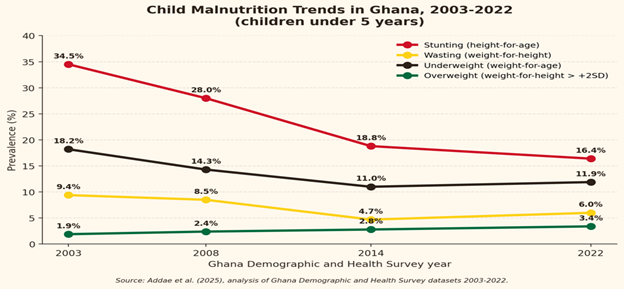
Figure 1. Trends in child stunting, wasting, underweight, and overweight in Ghana, 2003-2022 (Addae et al., 2025).
Age Classes
Throughout this blog article, references to “children” span several distinct developmental stages, each with different nutritional needs and different vulnerabilities to malnutrition. It is useful to keep these age bands in mind, since national surveys, feeding guidelines, and malnutrition-treatment protocols are all built around them.
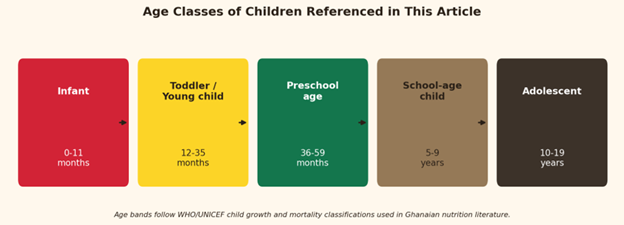
Figure 2. Age classes of children referenced in this article, following WHO/UNICEF child growth and mortality classifications (Cusick & Georgieff, 2016; Lenters et al., 2016).
The period from conception to a child’s second birthday often called the “first 1,000 days” is especially critical. During this window the brain forms nerve connections at its fastest lifetime rate, and the consequences of poor nutrition can be difficult or impossible to fully reverse later in life. Children who are malnourished in this period are more likely to experience impaired cognitive development, weakened immunity, and lower school performance that can persist into adulthood, affecting lifetime earning potential (Cusick & Georgieff, 2016). This is why nutrition programs in Ghana, from Child Welfare Clinics to school feeding, are so deliberately targeted at these early years.
II. Understanding Child Malnutrition: Undernutrition and Overnutrition
“Malnutrition” is sometimes assumed to mean simply “not enough food,” but the medical definition is broader. Malnutrition refers to deficiencies, excesses, or imbalances in a person’s intake of energy and nutrients, and it takes two broad forms in children: undernutrition and overnutrition (Lenters et al., 2016).
Essential Nutrients for Growth
Children need two broad categories of nutrients. Macronutrients carbohydrates, protein, and fat supply the energy and building blocks for physical growth and daily activity. Micronutrients vitamins and minerals such as iron, vitamin A, zinc, and iodine are needed in much smaller amounts but are just as essential, supporting immune function, vision, cognitive development, and healthy blood. Nutrient needs shift across childhood: infants rely heavily on breast milk for both macro and micronutrients, toddlers need energy-dense complementary foods introduced alongside continued breastfeeding, and school-age children and adolescents need increasing quantities of all nutrient groups to fuel rapid growth spurts.
Undernutrition
Undernutrition is usually described using three anthropometric indicators, each capturing a different kind of growth failure:
- Stunting: low height-for-age, reflecting chronic, long-term undernutrition and repeated infection.
- Wasting: low weight-for-height, reflecting acute, recent undernutrition or illness.
- Underweight: low weight-for-age, a composite measure that can reflect either stunting, wasting, or both.
In Ghana’s most recent Demographic and Health Survey data, roughly 16-17% of children under five were stunted, about 6% were wasted, and about 12% were underweight, with substantially higher rates in the Northern and Upper regions than in Greater Accra (Budu et al., 2025; Boah et al., 2019).
Overnutrition
Overnutrition, overweight and obesity was once thought of as a problem only for wealthier countries, but it is now rising among Ghanaian children too, particularly in urban centres. Studies in Accra and Kumasi have found overweight or obesity in about 17% of school-age children, with private-schooling, higher household wealth, and low physical activity all associated with increased risk (Aryeetey et al., 2017). A related study found that children who watched more than two hours of television a day had higher odds of being overweight, while those who walked or cycled to school and slept more than nine hours a night had lower odds (Adom et al., 2019). This dual pattern of undernutrition and overweight appearing side by side, sometimes even in the same household is what researchers now call the double or triple burden of malnutrition (Addae et al., 2025).
Common Micronutrient Deficiencies in Ghana
Even children who are growing at a normal rate for their height and weight can be micronutrient deficient, a condition sometimes called “hidden hunger.” A 2017 national micronutrient survey found that more than a third of Ghanaian preschool children were anemic, roughly one in five had iron deficiency or vitamin A deficiency, and a smaller share had zinc deficiency (Wegmüller et al., 2020). Iodine, iron, zinc, and vitamin A deficiencies remain among the largest contributors to Ghana’s disease burden in children, despite considerable progress from salt iodisation and other fortification programmes (Azagba-Nyako et al., 2025).
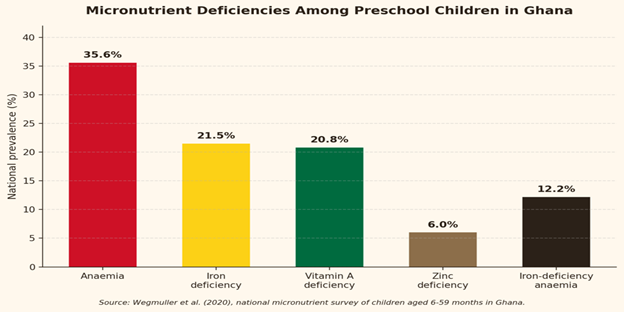
Figure 3. National prevalence of anaemia and selected micronutrient deficiencies among Ghanaian preschool children (Wegmüller et al., 2020).
These deficiencies are not merely abstract statistics: iron deficiency can cause anaemia and anaemia can cause fatigue and poor concentration, vitamin A deficiency raises the risk of infection and can affect vision, and zinc deficiency is linked with poor growth and weakened immunity (Azagba-Nyako et al., 2025).
III. Causes, Risk Factors, and Predisposition to Child Malnutrition
Malnutrition rarely has a single cause. Public health researchers commonly use UNICEF’s conceptual framework, which organises the drivers of malnutrition into three interconnected levels: immediate, underlying, and basic causes (UNICEF, 2021, as cited in Addae et al., 2025) as shown in the diagram below.
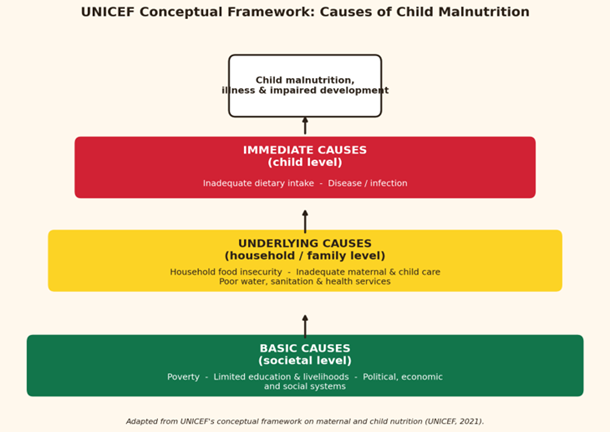
Figure 4. UNICEF’s conceptual framework for the causes of child malnutrition, adapted for the Ghanaian context (UNICEF, 2021).
Specific Risk Factors for Undernutrition
- Low birth weight and prematurity, which leave children with fewer nutritional reserves and short birth intervals and higher birth order, both linked with increased odds of stunting and wasting.
- Early cessation of breastfeeding or delayed initiation, which removes a key source of energy, protein, and immune protection.
- Household poverty and food insecurity, which limit dietary diversity and meal frequency.
- Limited maternal education, associated with lower nutrition knowledge and care practices.
Specific Risk Factors for Overnutrition
- Physical inactivity and increased screen time, children do play outside as much anymore
- Urbanization and higher household wealth, associated with easier access to processed, energy-dense foods.
- Frequent intake of sugar sweetened beverages like sodas, energy drink and processed juices.
IV. Severe and Moderate Acute Malnutrition: SAM and MAM
Among the forms of undernutrition, acute malnutrition commonly split into moderate acute malnutrition (MAM) and severe acute malnutrition (SAM) requires the most urgent clinical attention, because it carries a substantial risk of death if untreated (Lenters et al., 2016).
Figure 5. Comparing moderate and severe acute malnutrition, following WHO/UNICEF diagnostic and management criteria (Lenters et al., 2016; WHO, 2023).
V. Traditional Ghanaian Foods and the Four Star Diet
Key Staples
Ghanaian meals are built around energy-dense, carbohydrate-rich staples banku and kenkey (fermented maize/cassava dough), fufu (pounded cassava, yam, or plantain), waakye (rice and beans), tuo zaafi, and jollof rice among them. These staples are typically eaten with a soup, stew, or sauce that contributes protein, fat, and micronutrients: light soup or groundnut soup with fish or chicken, kontomire (cocoyam leaf) stew, or okro soup. On their own, staple-heavy meals tend to be filling but nutritionally narrow; it is the accompanying protein, legume, and vegetable components that round out a child’s diet (Kushitor & Colecraft, 2023).
The Four-Star Diet
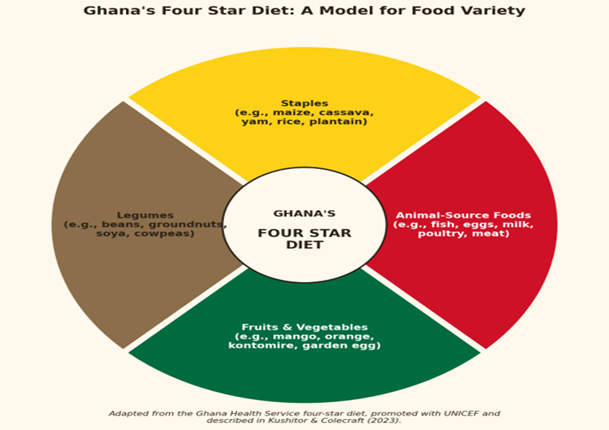
To help families translate “eat a variety of foods” into something concrete, the Ghana Health Service with support from UNICEF promotes the Four-Star Diet, a simple model built around four everyday food groups: staples, legumes, fruits and vegetables, and animal-source foods (Kushitor & Colecraft, 2023; UNICEF Ghana, n.d.). The idea is that a nutritious plate should draw from all four groups over the course of a day, rather than relying on starchy staples alone.
Role of Fruits and Vegetables
Ghana is home to an impressive range of local fruits and vegetables mango, pawpaw, orange, pineapple, garden egg, kontomire, and okro among them that can supply much of a child’s vitamin A and vitamin C needs at relatively low cost. Encouraging a “colourful plate” at every meal is a practical, culturally grounded way to increase micronutrient intake without necessarily increasing the cost of a family’s shopping basket.
Spotlight: Turkey Berry (Abeduro)
One under-used local vegetable worth highlighting is turkey berry (Solanum torvum), known in Twi as abeduro. It is a nutrient-dense fruit rich in iron, vitamin A, vitamin C, calcium, and zinc, and it has long been used in Ghanaian soups and stews. In a pilot study among adolescent girls in the Ahafo Region, a turkey-berry-fortified biscuit given over six weeks measurably improved participants’ haemoglobin levels and cognitive test performance compared with a placebo (Appiah et al., 2023). While more research is needed before firm dietary recommendations can be made, turkey berry is a good example of an affordable, locally available food that deserves a place in the conversation about fighting micronutrient deficiency in Ghana. Boost your daily micronutrient level with Daliha Turkey Berry Tea. Your natural wellness companion.
VI. Practical Tips for Parents
Creating Balanced Meals
The Four-Star Diet offers a simple mental checklist for any meal: is there a staple, a legume, a fruit or vegetable, and an animal-source food on the plate, even in small amounts? For infants aged 6-23 months, the World Health Organization recommends offering foods from at least five of eight food groups each day, alongside continued breastfeeding, with meal frequency increasing from two to three times a day at 6-8 months to three to four times a day (plus grow gradually with the child rather than mimicking adult servings; a toddler’s stomach is small, so nutrient-dense foods matter more than large volumes.one to two snacks) by 9-23 months (Kushitor & Colecraft, 2023). Portion sizes should
Making Nutrition Fun
- Involve children in age-appropriate meal preparation, washing vegetables, stirring, or helping to set the table builds familiarity with foods before they are even tasted.
- Use colour and shape playfully, arranging fruit or vegetables into simple patterns can make unfamiliar foods feel less intimidating.
- Eat together as a family where possible, shared, unhurried mealtimes are associated with more positive feeding practices and lower picky-eating scores (Cole et al., 2017).
- Grow something together, even a small backyard vegetable patch, as some Ghanaian school nutrition programmes have encouraged, can build a child’s connection to food (UNICEF Ghana, n.d.).
Using Turkey Berry Powder
For busy households and picky eaters, The Daliha Turkey Berry Powder is an excellent, shelf-stable innovation. The berries are gently dried at controlled temperatures to preserve vitamins, then milled into a fine, nutrient-dense powder. This powder can be seamlessly incorporated into a child’s favorite dishes without significantly altering texture.
Refreshing Turkey Berry Juice
The Daliha Turkey Berry Juice is a refreshing, vitamin-rich and an organic beverage that can easily replace sugary, ultra-processed sodas. It helps boost their energy after a very busy day of running up and down.
References
Addae, H. Y., Tahiru, R., Alhassan, A., Fuseini, A.-G., Iddrisu, M., Mensah, W., Azupogo, F., & Adokiya, M. N. (2025). Trends and determinants of the triple burden of malnutrition in Ghana: Analyses of two decades of demographic and health survey datasets. PLOS Global Public Health, 5(9), Article e0005078. https://doi.org/10.1371/journal.pgph.0005078
Adom, T., De Villiers, A., Puoane, T., & Kengne, A. P. (2019). Prevalence and correlates of overweight and obesity among school children in an urban district in Ghana. BMC Obesity, 6, Article 14. https://doi.org/10.1186/s40608-019-0234-8
Appiah, A. O., Tandoh, M. A., Puotege, P. S., & Edusei, A. K. (2023). The effect of a turkey berry (Solanum torvum)-fortified biscuit on the hemoglobin level and cognitive performance of adolescent females in the Ahafo Region of Ghana: A pilot study. International Journal of Food Science, 2023, Article 1388782. https://doi.org/10.1155/2023/1388782
Aryeetey, R., Lartey, A., Marquis, G. S., Nti, H., Colecraft, E., & Brown, P. (2017). Prevalence and predictors of overweight and obesity among school-aged children in urban Ghana. BMC Obesity, 4, Article 38. https://doi.org/10.1186/s40608-017-0174-0
Azagba-Nyako, J. M., Tortoe, C., Akonor, P. T., Padi, A., Boateng, J., & Otwey, R. (2025). Review of current strategies to address micronutrient deficiencies (MNDs) in Ghana: A scoping review. Journal of Nutrition and Metabolism, 2025, Article 6652716. https://doi.org/10.1155/jnme/6652716
Białek-Dratwa, A., Szczepańska, E., Szymańska, D., Grajek, M., Krupa-Kotara, K., & Kowalski, O. (2022). Neophobia—A natural developmental stage or feeding difficulties for children? Nutrients, 14(7), Article 1521. https://doi.org/10.3390/nu14071521
Boah, M., Azupogo, F., Amporfro, D. A., & Abada, L. A. (2019). The epidemiology of undernutrition and its determinants in children under five years in Ghana. PLOS ONE, 14(7), Article e0219665. https://doi.org/10.1371/journal.pone.0219665
Budu, E., Armah-Ansah, E. K., Gyawu, N. O., Tweneboah, R., Sekyi-Dickson, K., Oga-Omenka, C., & Otchi, E. H. (2025). Factors associated with inequalities in malnutrition among children in Ghana using the 2022 GDHS and WHO HEAT framework. BMC Public Health, 25, Article 2954. https://doi.org/10.1186/s12889-025-24356-x
Cole, N. C., An, R., Lee, S.-Y., & Donovan, S. M. (2017). Correlates of picky eating and food neophobia in young children: A systematic review and meta-analysis. Nutrition Reviews, 75(7), 516–532. https://doi.org/10.1093/nutrit/nux024
Cusick, S. E., & Georgieff, M. K. (2016). The role of nutrition in brain development: The golden opportunity of the “first 1000 days.” Journal of Pediatrics, 175, 16–21. https://doi.org/10.1016/j.jpeds.2016.05.013
Kushitor, S., & Colecraft, E. (2023). Development of a facilitator guide for nutrition education on overweight and obesity in the eastern region of Ghana. African Journal of Food, Agriculture, Nutrition and Development, 23(1), 22275–22293. https://doi.org/10.18697/ajfand.116.23010
Lenters, L., Wazny, K., & Bhutta, Z. A. (2016). Management of severe and moderate acute malnutrition in children. In R. E. Black, R. Laxminarayan, M. Temmerman, & N. Walker (Eds.), Reproductive, maternal, newborn, and child health: Disease control priorities (3rd ed., Vol. 2, Chapter 11). World Bank. https://www.ncbi.nlm.nih.gov/books/NBK361900/
Sewor, C., & Jayalakshmi, R. (2024). Trends of risk factors associated with childhood stunting and anaemia in Ghana: Evidence from the Demographic Health Survey and Multiple Indicator Cluster Survey (2003–2017). Public Health Nutrition, 27(1), Article e29. https://doi.org/10.1017/S1368980023002951
UNICEF. (2021). UNICEF conceptual framework on maternal and child nutrition. UNICEF.
UNICEF Ghana. (n.d.). A healthy brain and body start from what goes inside. Retrieved July 14, 2026, from https://www.unicef.org/ghana/stories/healthy-brain-and-body-start-what-goes-inside
U.S. Agency for International Development. (2018). Community-based management of acute malnutrition: Technical guidance brief. https://2017-2020.usaid.gov/global-health/health-areas/nutrition/technical-areas/community-based-management-acute-malnutrition
Wegmüller, R., Bentil, H., Wirth, J. P., Petry, N., Tanumihardjo, S. A., Allen, L., Williams, T. N., Selenje, L., Mahama, A., Amoaful, E., Steiner-Asiedu, M., Adu-Afarwuah, S., Rohner, F., Hodges, M. H., & Gebremedhin, S. (2020). Anemia, micronutrient deficiencies, malaria, hemoglobinopathies and malnutrition in young children and non-pregnant women in Ghana: Findings from a national survey. PLOS ONE, 15(1), Article e0228258. https://doi.org/10.1371/journal.pone.0228258
World Health Organization. (2023). WHO guideline on the prevention and management of wasting and nutritional oedema (acute malnutrition) in infants and children under 5 years. https://www.who.int/publications/i/item/9789240082830
Zucker, N. L., & Hughes, S. O. (2020). The persistence of picky eating: Opportunities to improve our strategies and messaging. Pediatrics, 145(6), Article e20200893. https://doi.org/10.1542/peds.2020-0893